Kids Drawing Games for Toddler
- 4.0
- Rating
- 10.00M
- Installs
- Free
- Price

 Analysis by App-foxy
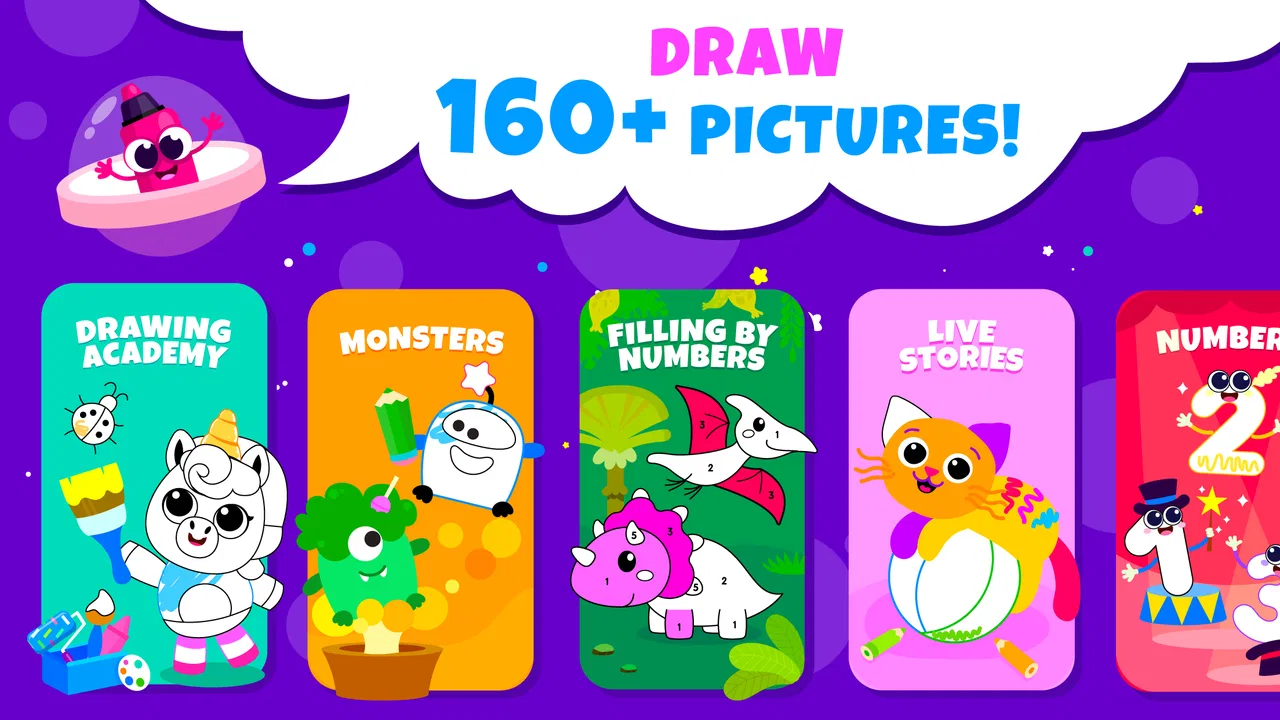
Kids Drawing Games for Toddler is the kind of educational game I would open when a young child wants to draw but needs something simpler than a full art app. Developed by Bini Games, it focuses on early coloring and drawing activities rather than trying to become a complete digital sketchbook. I found that its main appeal is the low-pressure start: a child can explore pictures and colors without needing to understand layers, brushes, menus, or complicated tools.
The game is free to download and suitable for Everyone, which makes it easy to consider for a shared family device. It has reached over 10 million installs and holds a 4.0 average from around 16 thousand ratings, so it is clearly familiar to many families. Those figures do not tell me whether every child will enjoy it, though. The better question is whether its guided style matches the child using it, and whether an adult is prepared to help when the experience does not begin smoothly.
Getting started without turning drawing time into troubleshooting
My first recommendation is to treat the initial launch as part of the setup, not something to hand over blindly. Young children are especially quick to tap through screens, choose an option by accident, or become frustrated before the drawing activity even appears. I would open the game first, check that it reaches its main activity area, and make sure the device responds properly to taps and swipes.
You May Also Like

 Blood Strike: 2.5 Anniversary
Blood Strike’s Loadouts Turn Every Drop Into a Tactical Gamble
A close look at Blood Strike’s custom loadouts: how fast access to signature weapons reshapes its battle royale rhythm, rewards preparation, and narrows the gap between fights.

 Pandora - Music & Podcasts
Pandora’s Music Is Easy to Start, but Harder to Recover
Pandora’s strength is its low-effort path from a seed to a station. Its weak spot is how much confidence it asks you to place in connection, setup, and quiet recovery.

 8 Ball Pool
 Is Built on Rivalries, Rematches, and Routine
A close look at the rivalries, rematches, shared routines, and unanswered safety questions that turn a quick pool match into a persistent mobile community.

 Samsung Music
’s Quiet Strength Is Playing What You Already Own
Its reach comes less from spectacle than from dependable access to a personal library. That simplicity is both the app’s strongest retention engine and its ceiling.

 AccuWeather: Weather Radar
AccuWeather Review: A Quick, Clear Forecast for Everyday Decisions
For everyday plans, the best forecast is the one you can understand quickly. AccuWeather makes rain timing, radar, and local conditions easy to act on, with a few trade-offs.

 Hill Climb Racing
Why Hill Climb Racing Still Turns Crashes Into One More Run
A tiny car, a bumpy hill and one more upgrade: Hill Climb Racing keeps resurfacing because its simple chaos makes every near-miss feel personal.
More From Our News Desk



This is particularly useful on a shared phone or tablet. A child may be using a device with an unfamiliar screen size, an active keyboard, a nearly full storage drive, or a background download taking attention away from the game. None of those issues necessarily comes from the drawing activity itself. A short adult check can prevent a child from deciding that the game is broken after a slow first screen.
The current version is 5.5.3 and it requires Android 8.0 or later. That requirement matters when the game is being installed on an older family tablet. If the device is below that software level, repeatedly trying to install it will not solve the compatibility problem. On a supported device, I would still check that the operating system is reasonably up to date and that the game has finished installing before starting a child’s session.
Where young players are most likely to get stuck
The likely friction is not the drawing itself but the transition between activities. A toddler may not understand that a picture, color choice, or control needs a deliberate tap. They may press repeatedly, drag across the wrong area, or leave the activity while trying to return to a previous screen. When that happens, I find it more helpful to demonstrate one action slowly than to take the device away and complete everything for them.
Another common problem is expectation. A child who is used to an unrestricted drawing canvas may expect to scribble anywhere. This game is built around toddler coloring and guided drawing, so the experience is better suited to children who enjoy filling in or following a visual prompt. If a child wants free-form drawing with many brush choices, the app may feel narrow even when it is working correctly.
I also would not assume that every tap means the child understands the interface. Toddlers often use a whole hand rather than a fingertip, and a screen protector can make light touches less reliable. Cleaning the screen, removing a thick case that overlaps the display, and placing the device on a stable surface can make the interaction feel much easier without changing anything inside the game.
Simple checks before blaming the game
If the app closes, freezes, or takes an unusually long time to respond, I would begin with ordinary device checks. I would close other demanding apps, restart the device, and try again with a reliable internet connection if the screen appears to be loading content. I would also confirm that the device has enough free space for normal operation. These are basic steps, but they are especially valuable on older tablets that are used by several family members.
When the game opens but touch input seems inconsistent, I would test the rest of the screen in another harmless app. If taps fail everywhere, the problem is more likely related to the device, screen, case, or protector. If other apps respond normally, restarting the game is a sensible next step. I would avoid repeatedly tapping during a delay, because that can make it harder to tell whether the game has frozen or is still processing the previous action.
For a child’s device, sound is another small source of confusion. I would check the physical volume controls, silent mode, and any connected headphones before assuming the game has no audio. If the child can see the activity but cannot hear anything, the problem may simply be the device’s current audio state. Keeping the volume modest is also sensible when the game is used in a car, waiting room, or shared room.
Because this is a free game with in-app purchases ranging from $1.99 to $44.99 per item, I would handle the store and purchase side before giving it to a child. An adult should be the one navigating any locked content or purchase prompt. The free starting experience may be enough for a child, but families should decide in advance whether they want to spend money rather than making that decision during an impatient moment.
A calmer workflow for everyday use
My preferred routine is short and predictable. I would choose a quiet moment, open the game myself, select an activity, and then invite the child to take over. This avoids handing over a device that is still loading or presenting an unfamiliar screen. It also gives the adult a chance to see whether the activity is appropriate for the child’s current mood and ability.
A realistic example would be a child waiting at a restaurant. Instead of opening a large creative app with many choices, I would start one coloring activity before the meal and let the child work through it at their own pace. If attention drifts, I would stop rather than pushing the child to finish. The game works better as a small, contained activity than as a promise of unlimited entertainment.
There is also a useful way to share the device without taking over. I would ask the child to choose the picture or color, then let them perform the actual tap or drag. If they miss, I would point to the correct area instead of correcting every mark. That turns the game into a gentle exercise in visual attention and hand control, rather than a demonstration where the adult does the important parts.
When a session is interrupted, I would first look for an ordinary way back to the activity: use the visible return control, reopen the game, or restart the device if it has stopped responding. I would not immediately clear app data or make deeper system changes, especially on a child’s shared device. Those steps can remove local progress or settings, and they are rarely the first thing worth trying for a simple interruption.
If the game repeatedly returns to the same problem after a restart, I would record what happened in plain terms: which screen was open, whether the device was online, and whether other apps behaved normally. That makes any later support request more useful. It is much better than reporting only that “the drawing does not work,” because the cause could be a loading issue, a touch problem, or an accidental navigation step.
What the game does well for early learners
The strongest part of this title is its focus. It does not ask a toddler to learn the vocabulary of professional art software. That makes it a reasonable first step for children who are interested in colors but are not ready for a blank canvas full of controls. I like that the educational purpose is visible in the activity itself: the child is practicing selection, movement, and visual matching while making something that feels like play.
It can also be useful for adults who want a quieter alternative to fast-paced games. The drawing theme gives the child something to concentrate on, and the parent can participate without needing to explain complicated rules. That said, I would still stay nearby with a toddler. The age rating of Everyone describes suitability in broad terms; it does not replace supervision, especially when the device can reach purchase screens or other parts of the operating system.
The game is a better match for guided creativity than for artistic independence. A child who enjoys choosing from a clear activity may settle into it quickly. A child who wants to invent characters, draw long stories, or control every detail may outgrow the format sooner. In that situation, a blank drawing app with fewer prompts could be more satisfying, while a paper and washable crayons would offer a completely different kind of freedom.
When another option makes more sense
I would choose this game over a general drawing app for a very young child who needs a simple starting point. I would not choose it for an older child looking for detailed illustration tools, freehand precision, or a serious creative project. Those users will probably prefer an app designed around an open canvas, even if it takes longer to learn.
It is also not the best substitute for hands-on art. Digital coloring can be convenient during travel or while waiting, but it does not provide the texture, resistance, or physical coordination of crayons and paper. For a child who is restless on a screen, switching to physical materials may solve the problem more effectively than changing digital apps.
Families should also think about the purchase model. The download is free, but optional items cost between $1.99 and $44.99 each. That does not automatically make the game unsuitable, yet it does mean the adult should control purchasing and explain which content is available. If a family wants an entirely open experience with no commercial prompts, a paid-up-front creative tool or offline art materials may be a better fit.
Another trade-off is repetition. Guided toddler activities can be reassuring because the child knows what to do, but that same structure may become predictable after repeated sessions. I would use it as one part of a small activity rotation: drawing here, physical coloring another day, and perhaps storytelling or building games at another time. That keeps the app useful without expecting it to provide every kind of learning.
Practical answers for parents during a session
If a child asks why a mark is not appearing, I would first check whether they are touching the intended area and whether the screen is registering taps elsewhere. I would then demonstrate a slower, lighter movement. If the whole device is unresponsive, I would restart it rather than repeatedly pressing the same control. This separates a child’s technique problem from a genuine device problem.
If the app seems stuck while opening, I would check the connection, wait briefly, close it, and relaunch it. I would also try a device restart if the issue continues. If other apps are also slow, freeing some storage or closing background apps may help. I would avoid promising the child that reinstalling will fix everything, because removing an app can affect local information and should be treated as a later step, not a casual first response.
If the child cannot find an activity after leaving it, I would guide them back through the visible navigation rather than changing settings. The goal is to teach a repeatable path: open the game, choose an activity, draw, and return. That small routine is one of the less obvious benefits of adult participation; the child gradually learns how to recover from a wrong tap instead of treating every mistake as a failure.
If the game works but the child remains frustrated, I would consider that an app-choice issue rather than a technical fault. Some children dislike guided coloring, some need a larger screen, and some simply want paper. No amount of troubleshooting changes that preference. The useful test is whether the child becomes more engaged after a short demonstration and a quieter setup. If not, I would move on.
My verdict after weighing convenience and limits
Kids Drawing Games for Toddler is a sensible free starting point for families seeking a focused educational drawing game from Bini Games. I like it most for short sessions with a toddler who benefits from clear visual activities and gentle adult guidance. Its Everyone rating, broad availability, and straightforward theme make it easy to try on a compatible Android device.
My recommendation comes with boundaries. Check the device before handing it over, keep an adult in charge of purchases, and do not confuse a guided coloring game with a full art studio. If loading, touch input, or sound behaves strangely, begin with simple device checks and test whether the issue affects other apps. That approach prevents unnecessary changes and helps identify whether the problem is actually inside the game.
The version currently available is 5.5.3, and Android 8.0 is the minimum operating system requirement. For a supported device, I think the game is worth trying when the goal is a calm, accessible drawing activity rather than unlimited creative control. I would skip it for children who already want advanced tools, for families seeking a completely purchase-free environment, or whenever physical art would better meet the child’s needs.
Overall, I would recommend it as a supervised part of a young child’s activity rotation, not as the only creative outlet. Its value comes from making the first steps into digital drawing approachable. Used that way, it can fill a useful gap between watching a screen and learning to create with one.
FAQs for Kids Drawing Games for Toddler
01What age group is Kids Drawing Games for Toddler suitable for?
Kids Drawing Games for Toddler is designed specifically for young children, typically ranging from ages 2 to 5. The app features intuitive controls and bright, engaging colors that cater to toddlers’ developmental stages, ensuring a delightful and educational experience. Parents can rest assured that the content is age-appropriate and safe.
02Does Kids Drawing Games for Toddler feature in-app purchases?
Yes, Kids Drawing Games for Toddler includes optional in-app purchases. These can enhance the gaming experience by unlocking additional features, tools, or drawing templates. Parents should monitor these purchases to manage spending and ensure their child doesn’t make unintended purchases.
03Is an internet connection required to use Kids Drawing Games for Toddler?
No, an internet connection is not required to use Kids Drawing Games for Toddler. The app is fully functional offline, allowing children to engage in creative drawing activities anywhere, anytime. However, an internet connection may be needed for downloading updates or making in-app purchases.
04How does Kids Drawing Games for Toddler support child development?
Kids Drawing Games for Toddler supports child development by enhancing fine motor skills, creativity, and cognitive abilities. Through drawing and interactive activities, children learn about colors, shapes, and patterns, fostering their artistic expression and problem-solving skills. The app creates a fun and educational environment for toddlers to explore.
05Can parents track their child's progress in Kids Drawing Games for Toddler?
Yes, the app includes a feature for parents to track their child’s progress. It allows parents to view completed drawings and the time spent on activities. This feature helps parents understand their child’s interests and developmental milestones, offering insights into their learning journey.
Pros
- Engaging and colorful interface.
- Simple controls for young kids.
- Variety of drawing tools available.
- Enhances creativity and imagination.
- No ads in the paid version.
Cons
- Limited free content.
- Occasional performance lags.
- In-app purchases for extras.
- No offline mode.
- Basic parental controls.

Kids Drawing Games for Toddler
Gallery